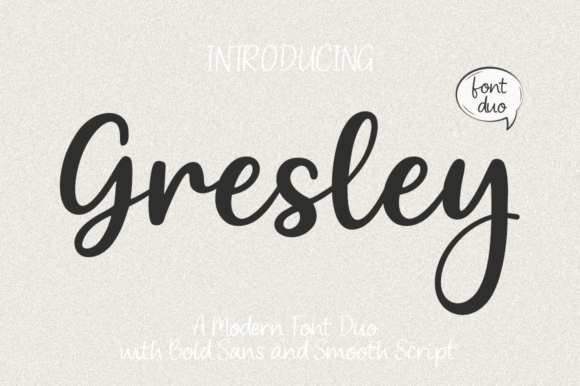
Gresley: The Type Duo Bridging Structure and Soul
Why a Single Typeface Is No Longer Enough
As designers, marketers, and content creators, we often find ourselves trapped in the cycle of endless searching. We look for a sans serif font that feels clean and authoritative, yet we also crave a script font that offers warmth and personality. Usually, achieving this balance means downloading two separate typefaces, crossing our fingers that the x-heights match, and spending hours tweaking the kerning so they don’t look awkward side-by-side. This is where Gresley enters the conversation, not just as a premium font, but as a complete design asset built specifically to solve the pairing problem before it even starts.
At its core, Gresley is a contemporary typeface duo. It combines a robust, geometric sans-serif framework with a fluid, handwritten font counterpart. The result is a harmonious system where the "headline" voice and the "accent" voice speak the same design language. If you have ever struggled to make a rigid, corporate header work alongside a whimsical signature, you understand the value of a tool designed to handle that tension. Gresley redefines modernity by offering this dynamic fusion—providing the structural integrity of a sans with the rhythmic flow of a script, all within a single family.
The Anatomy of the Blend
Looking closely at the sans serif font component of Gresley, you immediately notice the crystal-clear precision. It isn’t sterile or cold; rather, it possesses a structured confidence that commands attention. The letterforms are open and legible, making them ideal for titles, headlines, and UI elements where clarity is paramount. It serves as the anchor, grounding your layout with a sense of professionalism and order. This is the side of the typeface that handles the heavy lifting—delivering information, establishing hierarchy, and ensuring your brand identity looks polished and trustworthy.
Then, there is the script font variant. This isn't your typical, chaotic calligraphy that looks beautiful in a logo but fails the moment you try to write a full sentence. The Gresley script is designed with a rhythmic flow that mimics natural handwriting without sacrificing readability. It infuses a human touch into digital designs, bridging the gap between screen-based sterility and organic warmth. When used together, the vigor of the sans and the refinement of the script create a visual consonance that feels effortless. It is a fine balance—robust enough for a tech startup, yet smooth enough for a lifestyle brand.
Practical Applications: Where Gresley Shines
The true test of a creative font lies in its versatility. Gresley is impeccably designed for the contemporary creative sphere, but let’s break down exactly where it works best in real-world scenarios.
In branding and logo design, the duo offers a complete identity kit. You can use the sans portion for the primary wordmark to ensure it scales well on business cards and app icons, while the script can be used for the tagline or a secondary brand element. This creates immediate visual hierarchy and recognition. For packaging design, the script adds a tactile, artisanal feel to product names—think coffee bags, cosmetics, or boutique clothing—while the sans keeps the ingredients and legal information legible.
For editorial design and publishing, Gresley is a powerhouse. Imagine a magazine cover where the main feature title is set in the bold sans, but the subheading or pull quote uses the script to draw the reader’s eye. In web design, this combination helps break up the monotony of long-form reading. The sans works beautifully for navigation and body text, while the script can highlight key phrases or calls to action, improving audience engagement by adding visual variety.
Even for social media graphics, where attention spans are short, this typeface allows you to create fast, impactful content. You don't need to hunt for a matching font every time you create an Instagram story or a Pinterest pin. The assets are already designed to work together, ensuring your brand consistency remains intact across every platform.
Strategic Implementation for Professionals
Choosing a font is a strategic decision, not just an aesthetic one. When evaluating Gresley for your project, consider the personality of your audience. Because it blends a modern sans with a handwritten style, it appeals to a demographic that values authenticity but expects professionalism. It is particularly effective for entrepreneurs, bloggers, and small business owners who want to appear established yet approachable.
When testing font pairing beyond the duo itself, Gresley plays surprisingly well with others. If you need a third option for long-form body text, pairing the Gresley system with a neutral, readable serif font can create a sophisticated editorial look. Conversely, if you want a hyper-modern aesthetic, sticking strictly to the Gresley sans for all body copy works perfectly. I recommend reviewing the included styles—often weights ranging from light to bold—to see how the contrast levels affect your layout's mood.
One practical tip: pay close attention to readability when using the script. While the Gresley script is legible, all script fonts are best used for accents, short phrases, and headlines rather than dense paragraphs. Use it to draw the eye, then let the sans serif do the work of conveying the bulk of the information. This approach ensures your commercial font choice enhances, rather than hinders, the user experience.
Finally, regarding commercial licensing, always verify the terms before deploying Gresley in client work or mass-produced merchandise. Most premium fonts require specific licenses for web embedding or app usage. Treating your typography as a professional asset—rather than a free download—is a hallmark of a serious creative professional. By integrating Gresley into your toolkit, you are investing in a system that elevates your modern typography game, ensuring every project you touch feels cohesive, dynamic, and distinctly human.